
- 1300 E 9th Suite 1210 Cleveland Ohio 44114
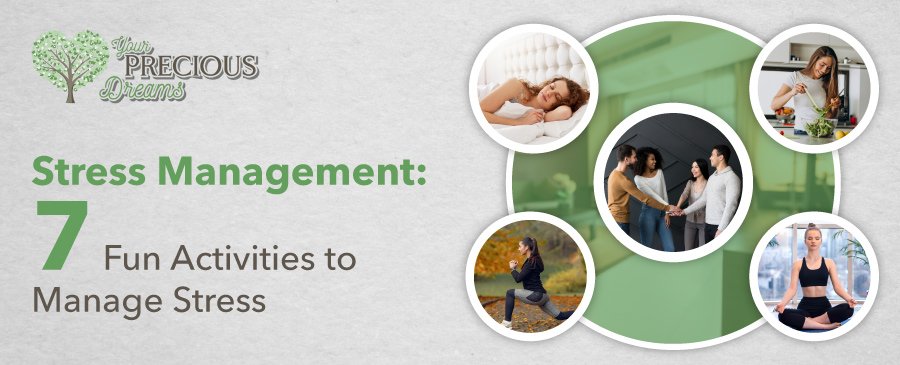
Stress Management: 7 Fun Activities That Actually Help
Everyone talks about stress like it is a personality flaw — something to push through, quietly. It is not. Stress is a biological event, and managing it is a learnable skill. This guide covers the science, the strategies, and seven activities that work for real people — not just those with a meditation cushion and a free afternoon.
What Is Stress — And Why Does It Deserve Your Attention?
Stress is your body’s response to a demand it perceives as exceeding its capacity to cope. That sounds clinical. Here is what it actually feels like: tight shoulders, shallow breathing, the inability to stop thinking about the same problem at 2am.
The mechanism behind it is cortisol and adrenaline — hormones that prime you for a threat. In the short term, useful. Chronically elevated, they are linked to high blood pressure, heart disease, obesity, depression, anxiety, and diabetes. That is not alarmist. That is the clinical record.
The World Health Organization classifies stress as one of the major health problems of our era. Research published in peer-reviewed medical literature describes stress coping methods as cognitive, behavioural, and psychological efforts — all of which are evidence-based, learnable, and effective across healthy populations and those managing a medical condition alike.
None of this requires a dramatic overhaul of your life. Most of it starts small.
“Exercise increases your overall health and your sense of well-being, which puts more pep in your step every day. But exercise also has some direct stress-busting benefits.” — Mayo Clinic
The Techniques That Actually Work
Hundreds of studies have been reviewed on this topic. The interventions below consistently show up in the evidence — not because they are trendy, but because they produce measurable outcomes.
| Technique | Type | Primary Benefit |
|---|---|---|
| Cognitive Behavioural Therapy (CBT) | Psychological | Reframes negative thought patterns; reduces anxiety & depression |
| Mindfulness-Based Stress Reduction (MBSR) | Mindfulness | Builds emotional regulation; lowers perceived stress |
| Aerobic Exercise | Physical | Boosts endorphins; reduces cortisol; improves mood |
| Progressive Muscle Relaxation | Relaxation | Lowers physical tension; reduces physiological stress markers |
| Diaphragmatic / Deep Breathing | Relaxation | Activates parasympathetic nervous system; slows heart rate |
| Social Support Networks | Social | Buffers perceived stress; promotes emotional resilience |
| Journaling / Expressive Writing | Mindfulness | Processes emotions; clears mental clutter; reduces anxiety |
| Balanced Nutrition | Physical | Regulates cortisol via magnesium & omega-3 intake |
Stress Management for Men and Women
The fight-or-flight response is universal. What differs is what happens next.
Women tend to produce more oxytocin under stress, which drives what researchers call the “tend-and-befriend” response — reaching out, seeking connection, building support. Men, shaped by higher testosterone, more often move toward action or problem-solving. Neither pattern is a character trait. Both are biology.
Where it matters practically: men are significantly less likely to seek help or discuss what they are feeling, which is a genuine health risk — not a toughness strategy. Women are more likely to ruminate, replaying stressors rather than processing and releasing them. Both patterns have costs when taken too far.
Men & Stress
- Problem-focused coping is the default — fix the source, close the loop
- Physical activity is a primary and effective stress outlet
- Social support is underused; emotional conversations are often avoided
- ‘Bottling up’ is common — and a reliable path toward burnout
- Testosterone amplifies the fight-or-flight intensity of the initial stress response
Women & Stress
- Social connection (‘tend-and-befriend’) is the instinctive first move
- Higher rates of self-reported stress and anxiety across most age groups
- More cortisol production increases emotional reactivity to stressors
- Rumination — re-processing the same stressor repeatedly — is a common trap
- Creative and expressive outlets are especially effective for emotional release
The practical upshot: men would benefit from leaning into connection and conversation more than feels natural. Women often benefit from action-oriented techniques that interrupt the rumination loop. These are not rigid categories — they are starting points for self-awareness.
Need more than just basic guidance?
Your Precious Dreams offers different mental health programs, such as Behavioral Counseling and Therapy, to help guide you along your journey.
The 4 A's of Stress Management
This framework is deceptively simple. Four strategies. One goal: get your stress below the threshold where it starts doing damage.
AVOID — Eliminate Unnecessary Stressors
Not every stressful situation deserves your energy. A lot of what drains people daily is avoidable — if they are honest with themselves. Saying no is a skill. So is letting the phone sit face-down. Start by auditing what you can simply stop agreeing to.
Make a list of your top stressors this week. Cross out anything you had no real obligation to take on. That is your starting point.
ALTER — Change What You Can
Some stressors are not going anywhere — but the way you engage with them can shift. This is where communication earns its keep. Use ‘I’ statements rather than accusations. Group similar tasks to reduce cognitive switching costs. Set time boundaries before conversations, not after they have already run long.
Small changes in how you operate tend to compound. One honest conversation can eliminate weeks of low-grade friction.
ADAPT — Change How You See It
Perfectionism is one of the most reliable stress generators going. When the standard is impossibly high, failure is guaranteed — and so is the anxiety that comes with it. Adapt means adjusting expectations without abandoning them. Reframe where you can. A sick day at home becomes time with your child. A delayed project becomes space to get the brief right.
A simple mantra — something like ‘I can handle this’ — is not a self-help cliche. It is a cognitive interrupt. It works.
ACCEPT — Let Go of What You Cannot Control
Loss. Illness. Other people’s behaviour. Some things simply are what they are. Fighting them does not make them change — it just uses up reserves you need elsewhere.
Acceptance is not passive. It is a deliberate choice to stop spending mental fuel on an outcome you cannot influence. Talk it through. Forgive where you can. Then move on.
7 Fun Activities to Manage Stress
The word ‘fun’ matters here. Compliance is the biggest problem in stress management — people know what they should do and do not do it. Activities that are genuinely enjoyable are activities people actually return to. Science backs this up: playful, creative, and social engagement can lower cortisol as effectively as clinical techniques. Seven that work:
1. Move Your Body — Any Way You Actually Like
Mayo Clinic puts it plainly: virtually any form of exercise — from aerobics to yoga — can act as a stress reliever. Physical activity boosts endorphin production while bringing cortisol down. You do not need a gym, a trainer, or an hour. You need movement.
A 6-week study of 185 university students found that aerobic exercise just two days per week significantly reduced overall perceived stress. The catch? You have to actually show up for it. Pick something you do not hate — a nature walk, a dance session in your kitchen, a quick swim — and make it non-negotiable. Twice a week. That is the floor.
2. Creative Expression: Art, Music & Writing
These are not soft suggestions. The biology here is real.
Research shows art-making, choir singing, expressive writing, and group drumming reduce mental distress and anxiety by modulating serotonin and lowering cortisol. Music does something specific: it modulates activity in the amygdala — the part of your brain that registers threat — and in some studies outperforms meditation for improving sleep quality.
Pick up a sketchbook. Start a playlist. Write three messy paragraphs about whatever is sitting on your chest. Skill level is entirely irrelevant. The output is not the point; the process is.
3. Spend Time in Nature
Time outside is not a lifestyle preference. It is a biological intervention.
Natural environments reduce cortisol, lower blood pressure, and shift the nervous system away from sympathetic (fight-or-flight) activation toward parasympathetic (rest-and-digest) functioning. The NHS lists outdoor activity as one of its primary stress-reduction recommendations, noting that even a few minutes of walking produces measurable relaxation.
A park counts. A garden counts. A short walk around the block during lunch counts. The barrier to entry here is almost zero.
According to the WHO, plenty of sleep, good connections, healthy eating, exercising regularly, and limiting yourself from mainstream/social media may help manage stress.
4. Connect Socially — With Intention
Social isolation amplifies stress. This is not anecdotal — a study of 163 Latinx college students found that lower support from friends, family, and partners directly correlated with higher perceived stress. Connection is a buffer.
This does not mean forcing yourself to socialise when depleted. It means one meaningful interaction: a phone call with someone you trust, joining a group around something you already care about, or showing up for someone else’s problem instead of sitting with your own. The NHS recommends a couple of shared activities or casual meetups per week as an effective, practical stress reliever.
5. Laugh — Seriously
Laughter increases oxygen intake, gives the heart and lungs a physiological boost, and releases endorphins. It improves immune function, reduces pain perception, and sustains a better mood for extended periods afterward. The mechanism is legitimate.
You do not need to manufacture joy. Watch something that reliably makes you laugh. Spend time with someone whose humour cuts through your own seriousness. Humour shifts perspective in a way that is hard to replicate — a problem that felt intractable often looks different after a genuine laugh.
6. Journaling & Gratitude Practice
Writing is one of the most underrated stress tools available. Journaling processes emotion, reduces mental clutter, improves emotional regulation, and lowers anxiety — all documented outcomes, not aspirational ones.
Healthline ranks it among the 16 most evidence-supported methods for stress and anxiety relief. You do not need structure. Vent, list, plan, or simply write three things you are grateful for each morning. Gratitude journaling, specifically, redirects cognitive attention away from threat and toward resource — which is exactly the shift stressed minds need.
7. Breathe Mindfully
This one requires nothing — no equipment, no space, no time block. Just awareness.
The NHS explains that breathing exercises activate the parasympathetic nervous system directly — reducing cortisol, slowing heart rate, and releasing physical tension in minutes. The 4-4 method is the simplest entry point: inhale for a count of 4, exhale for a count of 4. Repeat for two to five minutes.
Do it daily and it becomes reflexive — a reset you can trigger anywhere, in any situation, the moment you notice the tension climbing.
The Role of Stress Management Retreats
For persistent or severe stress, a structured retreat offers something that daily habits cannot: full removal from the environment generating the problem. That is not escapism. It is strategic.
Immersive retreat settings allow participants to focus entirely on recovery, skill acquisition, and perspective — without the constant low-grade demands of ordinary life pulling attention back. The results are documented:
- Retreats combine holistic practices — yoga, breathwork, mindfulness — with evidence-based therapy sessions
- Research confirms brief resilience retreats produce positive effects on anxiety, stress, and burnout levels
- MBSR retreats include a structured day-long retreat alongside weekly 2–2.5 hour sessions, with homework and practice built in
- Attendees consistently report meaningful reductions in perceived stress and improved emotional resilience following structured programmes
Can Behavioural Counselling Help?
Yes. The evidence on this is substantial. Cognitive Behavioural Therapy (CBT) is one of the most rigorously studied treatments in psychology. A review spanning 345 studies from 1987 to 2021 confirmed its effectiveness for stress and anxiety-related disorders across both clinical and general populations.
It works by targeting the cognitive patterns that sustain stress — avoidance behaviours, faulty beliefs, catastrophic thinking — and replacing them with more accurate, functional responses. Clinical evidence shows CBT significantly reduces the physiological stress response, including measurable decreases in sympathetic nervous system activity.
- CBT reduces depressive and anxiety symptoms across age groups and medical conditions
- Internet-delivered CBT (iCBT) shows small-to-moderate effect sizes sustained up to 6 months post-treatment
- Mindfulness-based cognitive therapy extends CBT to cultivate moment-to-moment awareness and emotional regulation
- Therapy works best alongside lifestyle changes — exercise, social connection, and consistent nutrition
If stress is affecting your work, your relationships, or your sleep on a regular basis, counselling is not a crisis measure. It is a practical tool. Seeking it early tends to produce better outcomes than waiting until things have compounded.
Disclaimer: The information on this blog is for informational and educational purposes only. While we strive for absolute accuracy, errors can occur. Readers should verify key details independently before making decisions based on this content.
Schedule Your Consultation
Latest Blogs

Quick Links
Office Address
1300 E 9th Suite 1210 Cleveland Ohio 44114
Email Address
yourpreciousdreams@yahoo.com
Your Precious Dreams | Powered By DocsMed © 2025 All Rights Reserved